Nikahnama is an official marriage contract under Pakistani Muslim Family Laws. Form of Nikahnama is a prescribed form under Rule 8 of the Muslim Family Laws Rules, 1961. Here all the clauses of Nikahnama in Pakistan, are explained in plain language. Each clause contains legal significance and carries distinct rights and obligations for both parties. Often, most of the clauses are ignored or misunderstood, especially by the bride at the time of Nikah ceremony because of lack of awareness and customary pressure.
Introduction
It is very important to fill Nikahnama with utmost attention as it is not just a legal requirement but also a protection of rights of both parties, specially the bride. Every clause must be explained to both the bride and groom, so both parties understand each provision.
It should never be rushed or signed under the customary stress. Both parties must take their time to understand and choose the right clauses, especially the bride must make sure that her future is secure, and her voice is heard.
Categorization of Clauses of the Nikahnama in Pakistan:
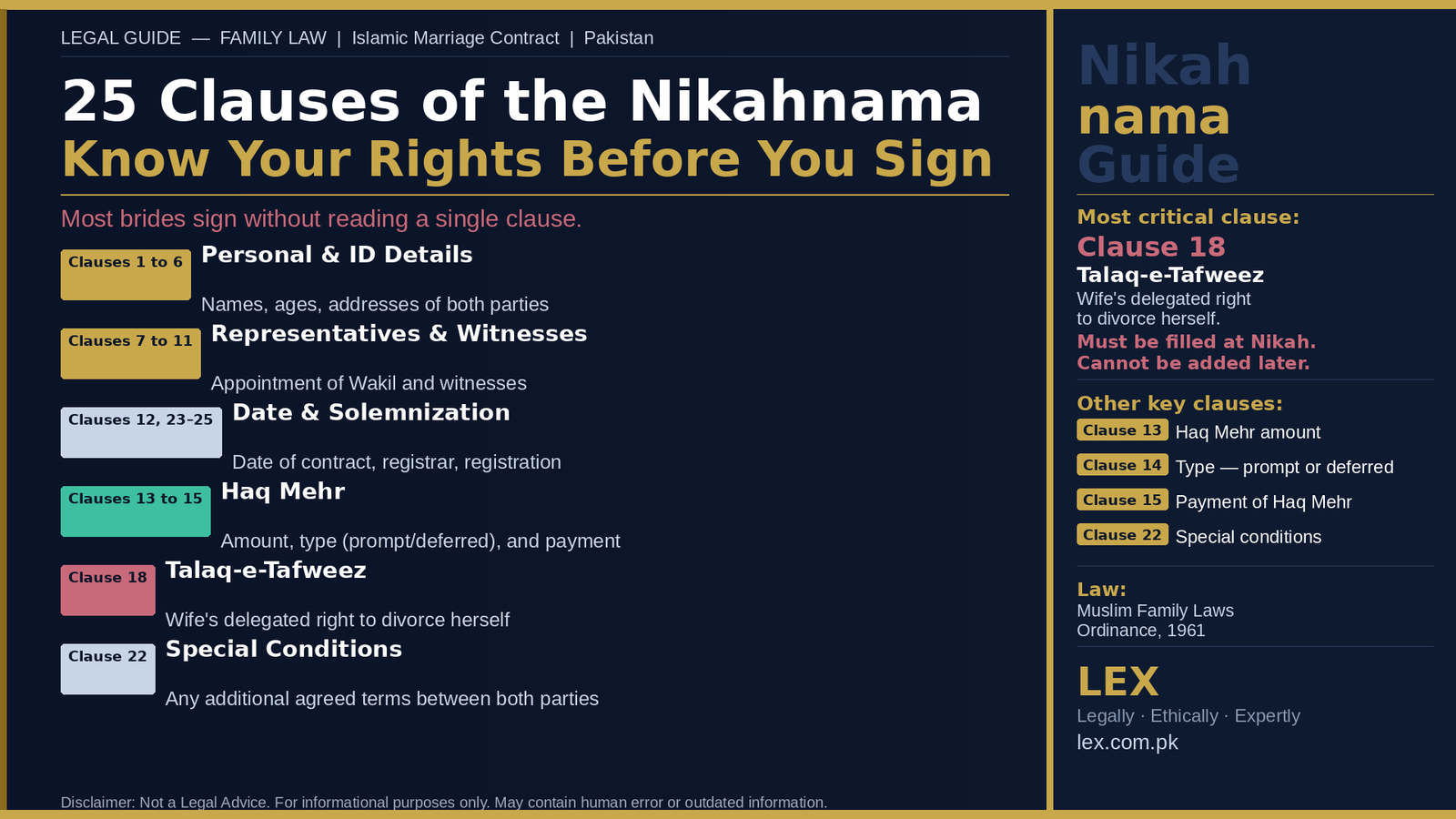
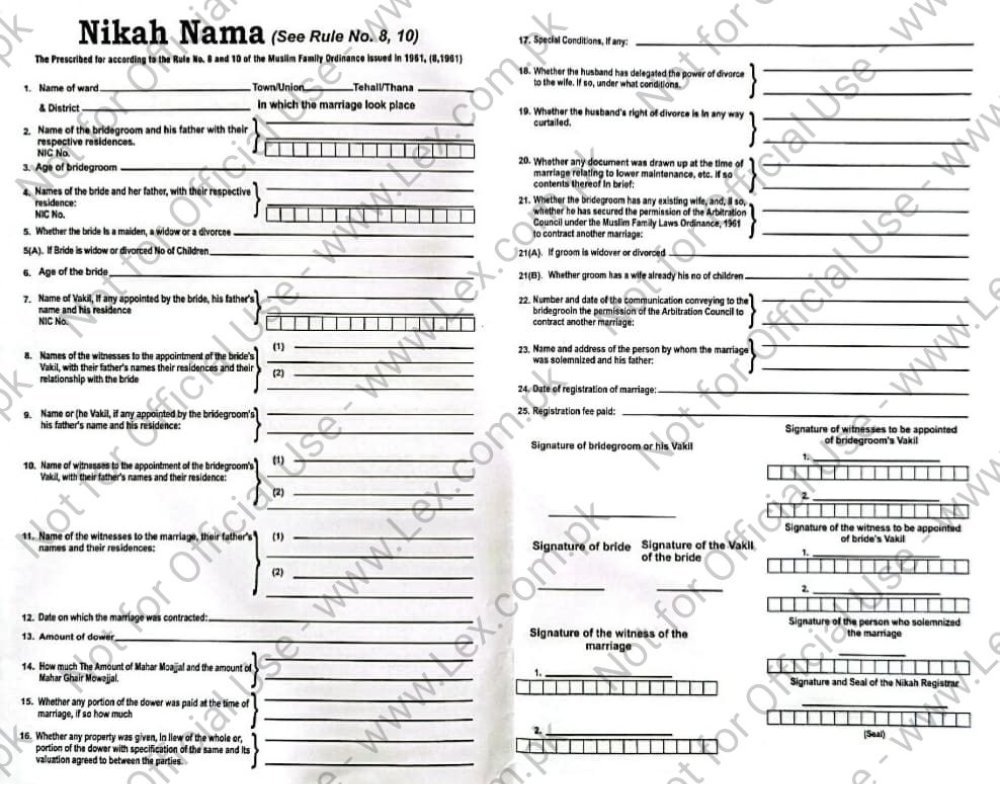
Below are the 25 clauses of Nikahnama in Pakistan organized into six major categories, each addressing a distinct aspect of the marriage contract.
I. Personal and Identification Details:
- Clause 1 (Place of Marriage),
- Clause 2 (Name and Address of the Bridegroom and His Father),
- Clause 3 (Age of the Bridegroom),
- Clause 4(Name and Address of the Bride and Her Father),
- Clause 5 (Marital Status of the Bride),
- Clause 6 (Age of the Bride).
II. Appointment of Representatives and Witnesses:
- Clause 7 (Appointment of the Bride’s Wakil),
- Clause 8 (Witnesses to the Bride’s Wakil),
- Clause 9 (Appointment of the Groom’s Wakil),
- Clause 10 (Witnesses to the Groom’s Wakil),
- Clause 11 (Witnesses to the Marriage).
III. Date and Solemnization:
- Clause 12 (Date of Marriage Contract),
- Clause 23 (Name of the Person Who Solemnized the Marriage),
- Clause 24 (Date of Registration),
- Clause 25 (Registration Fee).
IV. Dower (Haq Mehr) and Financial Matters:
- Clause 13 (Amount of Dower),
- Clause 14 (Breakdown of Dower: Prompt and Deferred),
- Clause 15 (Dower Paid at the Time of Marriage),
- Clause 16 (Property Given in Lieu of Dower).
V. Rights of the Wife and Special Conditions:
- Clause 17 (Special Conditions),
- Clause 18 (Delegation of Divorce to the Wife — Talaq-e-Tafweez),
- Clause 19 (Restriction on the Husband’s Right to Divorce),
- Clause 20 (Additional Agreements).
VI. Polygamy and Legal Permission:
- Clause 21 (Existing Wife and Permission for Another Marriage)
- Clause 22 (Permission Document Number and Date).
Explanation of Clauses of Nikahnama in Pakistan:
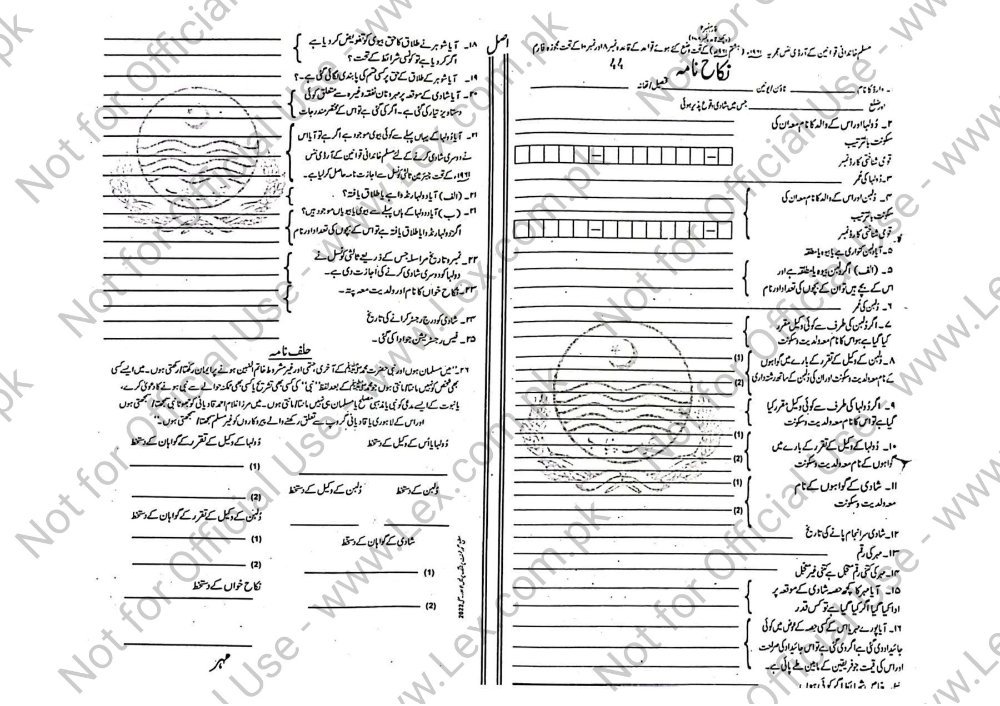
Below is the explanation of each clauses of Nikahnama in Pakistan and each clause is sorted numerically. You will find a Nikahnama form in Urdu and English in a PDF. We have attached the official form below for your reference.
Clause 1 of Nikahnama – Place of Marriage
At the top of Nikah Form, you see this clause. It records the name of the ward, union council, tehsil, thana, and district where the marriage took place. It is basically for ascertaining jurisdiction of Nikah registrar and for administrative records.
Clause 2 of Nikahnama – Name and Address of the Bridegroom and His Father
This part contains names and addresses of the bridegroom and his father. It confirms the identity and eligibility of bridegroom for marriage under Pakistani law.
Clause 3 of Nikahnama – Age of the Bridegroom
This clause records the age of the bridegroom, the groom must be of legal age for marriage in Pakistan. As per the latest enacted laws the minimum legal age for marriage is 18 years.
Clause 4 of Nikahnama – Name and Address of the Bride and Her Father
The other most highlighted part is similar to Clause 2, as it includes the bride’s and her father’s names and addresses.
Clause 5 of Nikahnama – Marital Status of the Bride
This clause inquire whether the bride is a maiden, widow, or divorcee. For example; if a bride is widow or divorcee she must observe Iddah. If bride is divorcee she must attach her Divorce certificate and in case widow; the death certificate of previous husband.
Clause 6 of Nikahnama – Age of the Bride
This clause records the age of the bride. This clause is a bar to child marriage. The bride must be of legal age for marriage i.e., of 18 years, as per the latest enacted laws the minimum legal age for marriage is 18 years.
Clause 7 of Nikahnama – Appointment of the Bride’s Wakil
If the bride appoints a representative (Wakil) to contract the marriage on her behalf, his name, father’s name, and address of the Wakil are recorded here. This is necessary only when if the bride is not present in-person. It is important and most common in cases of Online Marriage or Marriage where either bride or groom are overseas Pakistanis or foreigners and are residing outside Pakistan. However, representatives can be appointed for local marriages as well. This clause remains empty if no Wakil has been appointed.
Clause 8 of Nikahnama – Witnesses to the Bride’s Wakil
This clause documents the witnesses to the appointment of the bride’s Wakil. It is to make sure that the appointment of Wakil/Representative is been made with consent and transparency and without any undue influence.
Clause 9 of Nikahnama – Appointment of the Groom’s Wakil
Same as Clause 7, if groom to wants to appoint a Wakil, then, the Wakil’s name, father’s name, and residence must be recorded. This clause remains unfilled if no Wakil has been appointed.
Clause 10 of Nikahnama – Witnesses to the Groom’s Wakil
It records the names and addresses of the witnesses who verify the groom’s appointment of his Wakil.
Clause 11 of Nikahnama – Witnesses to the Marriage
As per the state law and Islamic law, two adult Muslim male witnesses must be present at the marriage ceremony. This clause 11 of the Nikahnama records the details of the witnesses to the marriage.
Clause 12 of Nikahnama – Date of Marriage Contract
This clause records the exact date the Nikah was solemnized. It is important for legal documentation and can affect future matters such as maintenance, inheritance or determination of legitimacy and parentage of a child.
Clause 13 of Nikahnama – Amount of Dower
This clause states the total amount of Haq Mehr in Pakistan, which is an obligatory payment by the groom to the bride. It is a woman’s exclusive right and must be determined with mutual consent.
Clause 14 of Nikahnama – Breakdown of Dower: Prompt and Deferred
The dower is divided into mu’ajjal (prompt) and gher-mu’ajjal or mu’wajjal (deferred) portions. This clause records how much is to be paid immediately and how much later.
Clause 15 of Nikahnama – Dower Paid at the Time of Marriage
Clause 15 of the Nikahnama reflects the portion of the dower that is paid instantly at the time of the marriage. i.e., Muajjal (Prompt Dower).
Clause 16 of Nikahnama – Property Given in Lieu of Dower
In case where any movable or immovable property is given as dower instead of cash or money, this clause has to be filled with a detailed description along with the agreed valuation of that property.
Clause 17 of Nikahnama – Special Conditions
This important is mostly left blank. Whereas, this clause 17 of Nikahnama is a powerful clause that allows the bride or groom to include any agreed-upon conditions. Terms may can include the right to education, employment, or residence arrangements. This clause can be used to safeguard women’s rights in Nikahnama and should be taken seriously.
Clause 18 of Nikahnama – Delegation of Divorce to the Wife (Talaq-e-Tafweez)
Clause 18 of the Nikahnama addresses whether the husband delegates the right of divorce to the wife, a legal and religiously sanctioned concept known as Talaq-e-Tafweez (طلاقِ تفویض). This provision allows the wife to pronounce divorce upon herself without requiring the husband’s consent, either conditionally or unconditionally, depending on how it is specified in the contract. It is different from Khula, which requires court intervention, as Talaq-e-Tafweez is a direct and legally binding form of divorce under Section 8 of the Muslim Family Laws Ordinance, 1961.
Recognized by both Sunni and Shia schools of thought, and supported by Pakistani case law such as 2013 CLC 1625, 2016 YLR 15, and 2011 PLD 265, the right is considered irrevocable unless reconciliation occurs during the mandatory 90-day notice period. Legally, the divorce takes effect after this period once the Union Council completes the procedural requirements. It is vital that women understand this right and assert its inclusion in the Nikahnama. Sadly, Clause 18 is often crossed out without consent or explanation.
Clause 19 of Nikahnama – Restriction on the Husband’s Right to Divorce
This clause allows the bride to negotiate limitations on the groom’s right to divorce, such as mandatory arbitration or written reasons. This can help prevent unilateral and unjustified divorces.
Clause 20 of Nikahnama – Additional Agreements
This clause 20 of Nikahnama is an optional extension to the marriage contract. It notes any prepared or any other agreement between parties if prepare then a brief summary of it must be included here. That document is also legally binding on both parties.
Clause 21 of Nikahnama – Existing Wife and Permission for Another Marriage
In case of polygamy, this clause requires the groom to declare if he has a existing wife of wives and whether he has secured written permission for a second marriage. Additional marriage cannot be registered without fulfilling this mandatory clause.
Clause 22 of Nikahnama – Permission Document Number and Date
If groom has secured a written permission for a second marriage or additional marriage, the official number and date of that document are to be recorded.
Clause 23 of Nikahnama – Name of the Person Who Solemnized the Marriage
The name, address, and father’s name of the Nikah solemnizer are entered here. This confirms the legitimacy of the officiating authority.
Clause 24 of Nikahnama – Date of Registration
This is the official date on which the marriage was registered with the local authority. A date of marriage can be different from date of registration.
Clause 25 of Nikahnama – Registration Fee
The amount of the registration fee that is paid to the Nikah solemnizer is recorded here.
How LEX Encourages Women Rights?
At LEX, we believe that a woman who knows her rights is a woman who cannot be silenced. We have already wrote many guides on Dissolution of marriage, Khula, Khula for overseas Pakistanis, Child Custody, Child Maintenance, etc. I felt need for this guide as it is first step where a women should know learn her rights.
That is why we write guides like this one so that a bride sitting in her room the night before her Nikah can read it, understand it, and walk into that ceremony prepared.
The clauses of nikahnama in Pakistan are not just paperwork. Clause 17 is your voice. Clause 18 is your protection. Clause 19 is your boundary. These rights exist because the law put them there for you. Our job is simply to make sure you know about them before someone quietly crosses them out.
If you are about to get married and you want someone to walk you through your Nikahnama before you sign, we are here. If your rights have already been violated and you need legal guidance, we are here for that too. A quick consultation can change the entire direction of your case.
Reach out to us at LEX. The first step is simply asking.
Download Nikahnama Forms in PDFs
Click the buttions below to download the official Nikahnama form in Urdu and English. Having the form in front of you while reading this guide will help you understand all the clauses of nikahnama in Pakistan.
Below are the Images of Nikahnama Forms both in English and Urdu.
Final Words
I have seen women walk into the most important legal moment of their lives without being given a single minute to read what they are signing. The Nikahnama is not just a form, it is a contract, and like every contract, all clauses of Nikahnama in Pakistan deserves to be read, understood, and negotiated.
Every clause in it exists for a reason. The dower is your right, not a formality. The special conditions are your voice, not an empty box. And Clause 18 the one that is crossed out so casually, sometimes without even telling you is your safety net. You deserve to know it exists.
I write this not to create fear around marriage, but to ensure that when you sign that document, you do so with full knowledge of what you are agreeing to. A marriage built on informed consent, on equal understanding, is far stronger than one built on rushed signatures and silent assumptions.
To every bride reading this: please take your time. Ask questions. Demand explanations. You are not being difficult you are being wise. The law gives you rights. Make sure your Nikahnama reflects them. In case you are facing difficulty to understand any of the clauses, we are just a text away. You can contact our firm LEX and we will assist you.
Disclaimer
The information provided in this blog is for general awareness and educational purposes only. It does not constitute legal advice and should not be treated as such. Every case and situation is different, and the law can be interpreted differently depending on the circumstances. If you need legal advice specific to your situation, please consult a qualified lawyer before making any decisions. LEX does not assume any liability for actions taken based on the information published in this blog.
Frequently Asked Questions (FAQs)
What are the clauses of Nikahnama in Pakistan?
The Nikahnama in Pakistan contains 25 clauses in total. I have grouped them into six categories: personal identification details, appointment of representatives and witnesses, date and solemnization, dower and financial matters, rights of the wife and special conditions, and polygamy and legal permission. Each clause carries legal weight and must be filled carefully before signing.
What is Nikahnama and why is it important?
Nikahnama is the official Muslim marriage contract in Pakistan, registered under Pakistani Muslim Family Laws. In simple terms, it is a legally binding document that records the rights and obligations of both the bride and the groom. I always say that it is not just a form, it is your legal protection for the rest of your marriage.
How to fill Nikahnama in Pakistan?
Filling the Nikahnama correctly requires attention to every clause. Start with personal details of both parties, then move to dower amount, special conditions, and most importantly, Clause 18 regarding Talaq-e-Tafweez. Never leave Clauses 17, 18, or 19 blank without fully understanding what you are giving up. If in doubt, consult a lawyer before signing.
What is Clause 18 of Nikahnama — Talaq-e-Tafweez explained?
Clause 18 of the Nikahnama is about Talaq-e-Tafweez, which means the husband delegates his right of divorce to the wife. This allows the wife to dissolve the marriage herself without going to court, unlike Khula. It is legally recognized under Section 8 of the Muslim Family Laws Ordinance 1961 and is supported by both Sunni and Shia schools of thought. Sadly, this clause is often crossed out without the bride’s knowledge or consent.
Where can I get the Nikahnama form in Urdu PDF?
The official Nikahnama form in Urdu is issued by the Union Council and is the standard form used across Pakistan for Muslim marriages. We have attached both the Nikahnama form in Urdu and the Nikahnama form in English on this page for download. Having the form in front of you while reading this guide will help you understand each clause as it appears on the actual document.
What are women’s rights in Nikahnama Pakistan?
Women’s rights in the Nikahnama are far stronger than most people realize. The law gives a bride the right to negotiate conditions, secure her dower, delegate divorce, and restrict unjustified talaq, all within the four corners of the Nikahnama itself. The problem is not the law. The problem is that most women are never told these rights exist.
What is Haq Mehr in Pakistan and how is it written in Nikahnama?
Haq Mehr in Pakistan is the mandatory payment a husband owes his wife as part of the marriage contract. In the Nikahnama it appears across Clauses 13 to 16. It can be cash, gold, property, or anything of agreed value. Part of it can be paid immediately at the time of Nikah and the rest deferred. One thing I always stress that Meher belongs entirely to the wife. It cannot be taken back, returned under pressure, or dismissed as a tradition.
Is this a Nikahnama guide for brides in Pakistan?
Yes, and that is exactly why I wrote it. This is a complete Nikahnama guide for brides in Pakistan written in plain language, without legal jargon, so that every woman walking into a Nikah ceremony knows what she is agreeing to. You deserve that knowledge before you sign, not after.