AT A GLANCE — WHAT THIS RULING MEANS FOR WORKING AND OVERSEAS WIVES
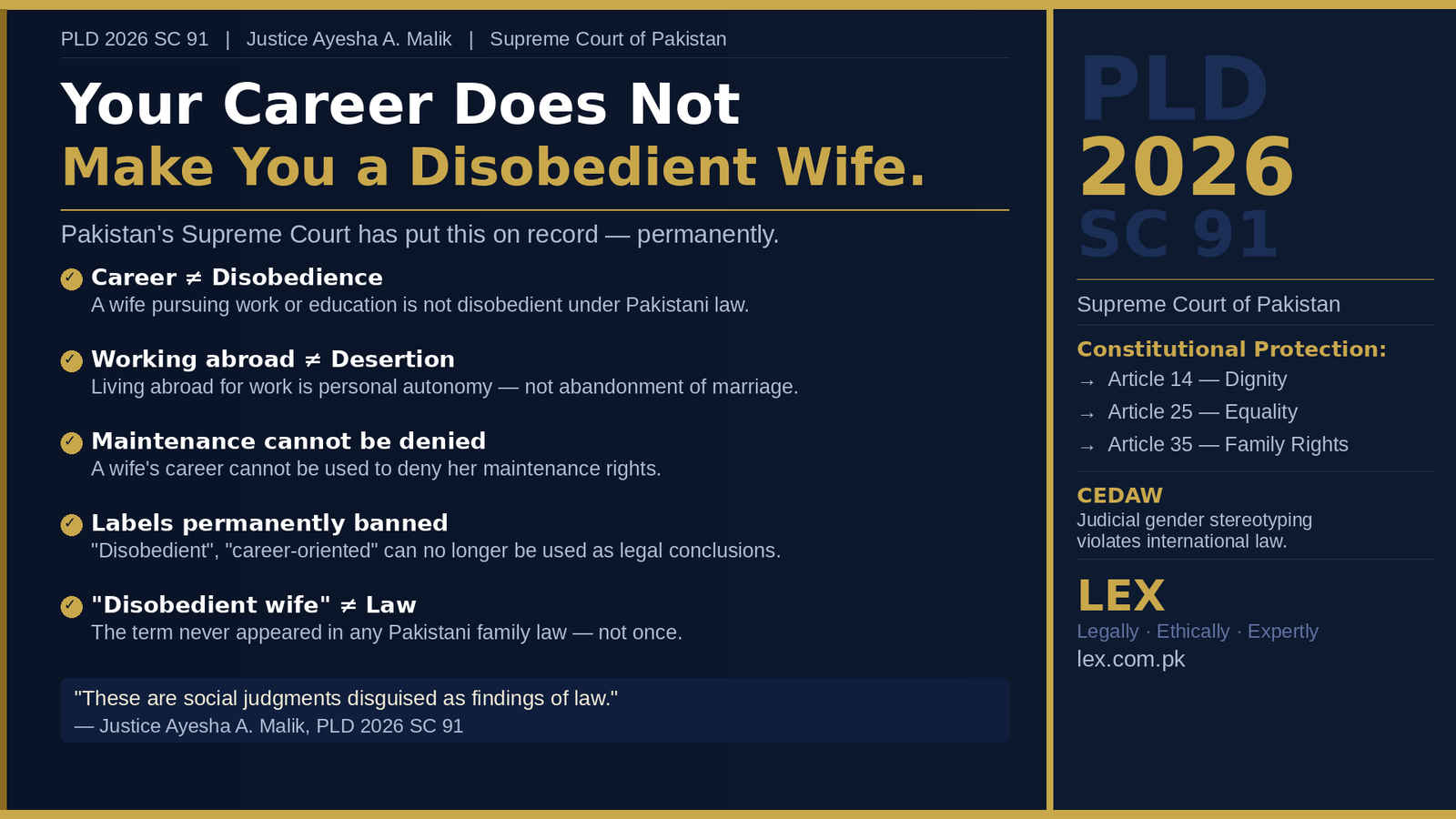
- A wife pursuing her career or education is NOT disobedient wife under Pakistani law.
- A wife living abroad for work is NOT deserting the marriage. Instead it is personal autonomy.
- Maintenance CANNOT be denied because a wife works, lives separately, or is career-oriented.
- Courts are banned from using ‘disobedient wife’, ‘self-deserting’, ‘career-oriented’ in or as legal conclusions.
- This violates Articles 14, 25, and 35 of the Constitution of Pakistan.
- Pakistan’s CEDAW obligations require courts to stop applying gender stereotypes in judgments.
- A husband’s illegal second marriage cannot be justified on the wife’s career or independence.
Rulings: PLD 2026 SC 91 (Justice Ayesha A. Malik Judgement)
Introduction
A wife filed for dissolution of marriage in a Pakistani Family Court citing cruelty, non-payment of maintenance, and her husband’s illegal second marriage. Three courts dismissed her grounds and gave her Khula without asking for it. They called her a disobedient wife. They noted she was career-oriented as a character flaw. They concluded she had created circumstances that compelled her husband to take a second wife. The husband had been convicted under Section 6(5) of the Muslim Family Laws Ordinance 1961 for that second marriage. Three courts ignored the conviction entirely and focused instead on labeling the wife. Then the case reached the Supreme Court of Pakistan. Justice Ayesha A. Malik wrote the judgment in PLD 2026 SC 91. This blog is about what that judgment means specifically for you.
Was She a Disobedient Wife — Or Was the Court Just Wrong?
Before we get to the legal analysis, read these words from the Family Court judgment in Dr. Seema’s case and ask yourself how they feel.
The court called Dr. Seema a “disobedient wife” and a “self-deserted lady.” It found that she had “created such circumstances which compelled the defendant to contract a second marriage.” It noted that she was “career-oriented” and “free-minded” stated as criticisms. It was held because she wanted to go to Ireland to work, she was disobedient, and therefore not entitled to maintenance.
These are not legal findings. Justice Ayesha Malik said exactly that. These are “social judgments disguised as findings of law.” as these findings shields the husband’s conduct and punish the woman for being herself.
“These are social judgments disguised as findings of law. They shield the husband’s conduct and punish the woman for being herself.” — PLD 2026 SC 91
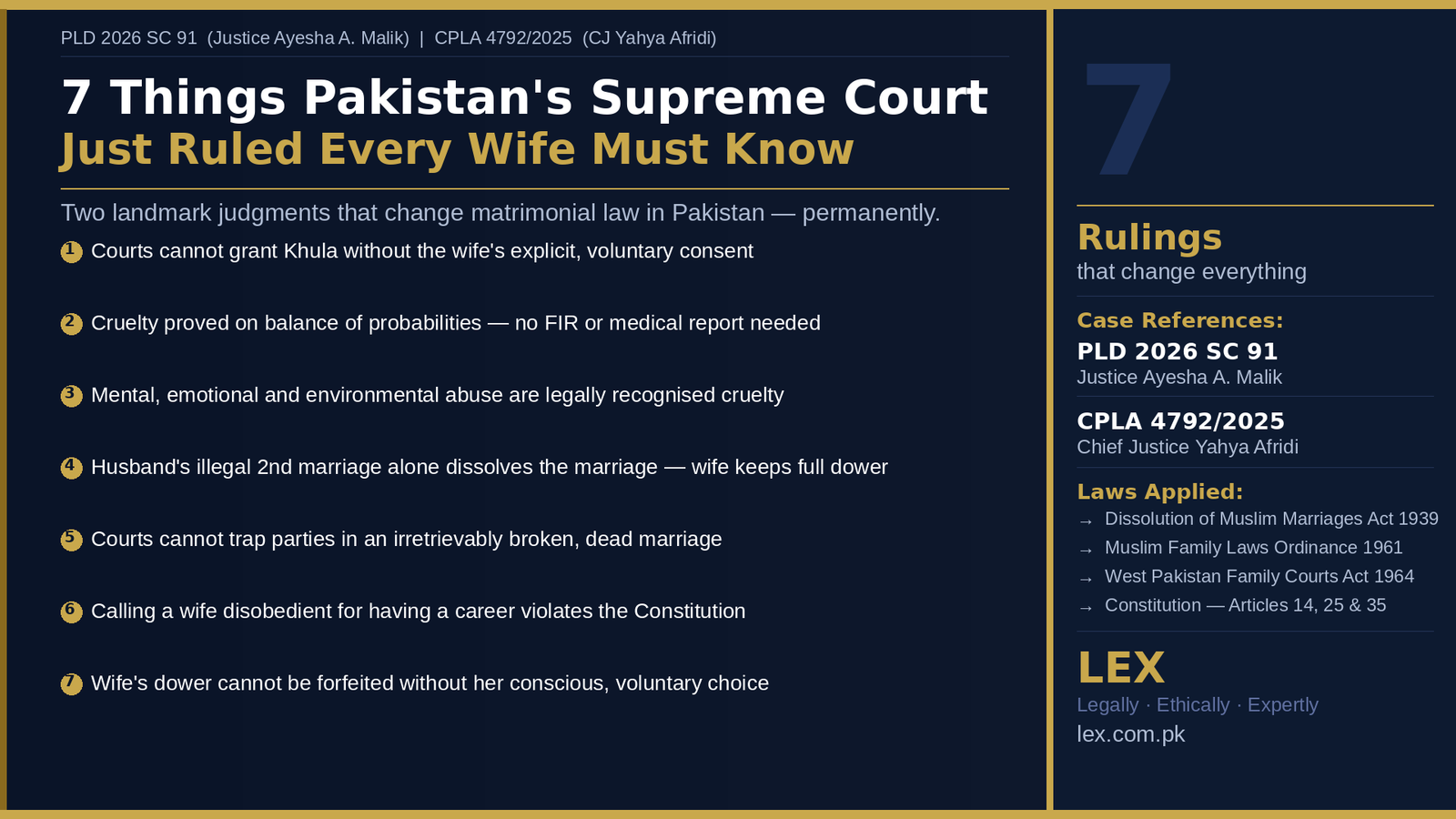
full analysis of the 7 key rulings’ → lex.com.pk/blogs/khula-without-consent-pakistan-supreme-court/
What Did Family Courts Actually Mean by ‘Disobedient Wife’?
The word ‘disobedient’ does not appear in the Muslim Family Laws Ordinance 1961. It is not in the Dissolution of Muslim Marriages Act 1939. It is not in the West Pakistan Family Courts Act 1964. It does not appear anywhere in the Constitution of Pakistan.
It was never a legal standard. It crept into court reasoning over decades and stayed there used to describe wives who left matrimonial homes due to abuse, who pursued education or careers, who moved abroad for work, who filed for dissolution, or who simply refused to return to unsafe homes. Once applied, the consequences were swift. Maintenance denied. Dower questioned. Cruelty claims dismissed. The husband’s illegal conduct excused.
In the case that led to PLD 2026 SC 91, the Family Court even used the fact that the wife had studied in a co-education system as evidence of her disobedience. Her desire to go to Ireland to work was treated as defiance of the marriage. Supreme Court wrote that these were not legal findings. They were social judgments dressed in legal language and they cost the wife everything she was legally entitled to. Justice Ayesha Malik’s ruling is unambiguous on this point. The disobedient wife label was never the law. It was an opinion. Courts that used it were not adjudicating instead they were imposing a social standard the Constitution explicitly prohibits.
Is a Working Wife a Disobedient Wife Under Pakistani Law?
No. A wife who works, studies, pursues a profession, or builds an independent life is not disobedient under Pakistani law. PLD 2026 SC 91 held this explicitly and grounded it in the Constitution.
Justice Ayesha Malik held that a wife’s desire to work or study including abroad is the exercise of personal autonomy. It is protected under the Constitution of Pakistan, 1973:
- Article 14 of the Constitution — the fundamental right to dignity
- Article 25 — the right to equality and non-discrimination
- Article 35 — the state’s obligation to protect the family and the rights of women within it
The Role of CEDAW in Pakistan
Pakistan is also a signatory to CEDAW. It is the Convention on the Elimination of All Forms of Discrimination Against Women. CEDAW’s General Recommendation 35 (2017) specifically identifies judicial stereotyping of courts applying harmful assumptions about women’s roles as a form of gender-based discrimination that states are obligated to eliminate.
When a Family Court judge writes ‘career-oriented’ as a criticism in a legal judgment, that is judicial stereotyping. And Pakistan’s Supreme Court has now said it violates international law obligations.
The ruling drew a clear, deliberate line between a wife’s personal choices and the legal assessment of a marriage. A woman’s career, ambitions, and professional life are hers. They are not evidence of marital misconduct. They cannot be used to deny her maintenance, dismiss her cruelty claims, or justify her husband’s illegal acts.
“Wanting a career does not make you disobedient. Pakistan’s Supreme Court confirmed it and the Constitution always said it.”
For Every Overseas Pakistani Woman Called Disobedient for Having a Career — The Law Is on Your Side
A wife living abroad, working, independent, not residing in the matrimonial home is routinely and in stereotypical manner is labeled disobedient and denied her rights. These rulings speak directly to that Autonomy and Self-sufficiency is not misconduct or disobedient.
Can a Woman be tagged as Disobedient Wife for Living and Working Abroad?
The answer from Pakistan’s Supreme Court is clear: No.
We already know the pattern. If you are a Pakistani wife living in the UK, USA, Canada, UAE, Australia, or anywhere abroad working, building a life, financially independent. When a marriage breaks down and proceedings begin in Pakistan, your entire life abroad is turned against you.
You are tagged as a disobedient wife for not living in the matrimonial home. They calls you a deserter for not returning when summoned. Denies your maintenance on the basis that you ‘chose’ to live separately. And sometimes your independence is been used as evidence that you have compelled your husband to take a second wife.
PLD 2026 SC 91 addressed this pattern directly. The wife in the case under discussion wanted to go to Ireland to work. The Family Court treated this fact as the defining proof of her disobedience, the reason for denying her maintenance and justification of her husband’s illegal second marriage. The Supreme Court said that was constitutionally wrong. A wife’s decision to work abroad is personal autonomy. It is not misconduct. It is not desertion. It is not a ground for denying maintenance or for excusing any conduct by the husband.
The co-education detail matters here too. The Family Court cited the fact that the wife had studied in a co-education system as part of its case against her. This is how deep the stereotyping went that her educational background was used as evidence of disobedient character. The Supreme Court rejected all of it.
“The Family Court failed to recognize that the petitioner’s desire to pursue her career or education abroad is not disobedience and is not to be equated to misconduct — rather it is an exercise of her personal autonomy.” — PLD 2026 SC 91
If this is your situation:Your independence, your career, your life abroad cannot be used against you in a Pakistani Family Court. The Supreme Court has now said so explicitly. If a court has already made findings against you on this basis, those findings were legally wrong — and you may have grounds to challenge them.
Can a Husband Deny Maintenance to a Working or Career-Oriented Wife?
No. This is one of the clearest legal consequences of PLD 2026 SC 91 and one of the most practically significant for working wives and overseas Pakistani women.
Maintenance is the husband’s statutory obligation under Section 9 of the West Pakistan Family Courts Act 1964. It exists for the duration of the subsistence of the marriage. It is not conditional on the wife’s obedience, her location, her career choices, or any standard of domestic compliance a court might informally apply.
In the case behind PLD 2026 SC 91, the nikahnama specified Rs.10,000 per month as maintenance. The wife led evidence through herself and her mother that maintenance had never been paid after certain year of marriage. The husband’s own evidence and witnesses said nothing about having paid maintenance. He produced no documentary proof of payment. The Family Court ignored all of this and dismissed the maintenance claim entirely because the wife was labeled disobedient. The Supreme Court reversed that finding completely.
The correct legal test for maintenance has nothing to do with obedience. It is simply: was the marriage subsisting? Was maintenance paid? If the marriage was subsisting and maintenance was not paid, it is owed. Full stop.
“Alleged disobedience is not a legal ground to deny maintenance. The Family Court’s presumption that only an obedient wife is entitled to maintenance must be replaced with the legally correct position — maintenance is a husband’s statutory obligation during the subsistence of the marriage.” — PLD 2026 SC 91
If your maintenance was denied because a court called you disobedient: That denial was legally wrong. LEX handles maintenance recovery cases for women — in Pakistan and for overseas Pakistanis managing proceedings remotely. A consultation will tell you where you stand.
What Words Pakistani Family Courts Are No Longer Permitted to Use Against Wives
PLD 2026 SC 91 named specific words and directed courts to consciously move away from all of them. This is unusual in Pakistani jurisprudence that a Supreme Court judgment identifying exact language used by a lower court and declaring it constitutionally impermissible.
The banned terms include:
- “Disobedient wife” — used to dismiss claims without examining conduct on its legal merits
- “Self-deserted lady” — used to blame a woman for leaving an unsafe or abusive home
- “Mummed” — an archaic term applied to women who assert their legal rights
- “Career-oriented” — used as criticism implying professional ambition is incompatible with marriage
- “Free-minded” — used to negatively characterize a woman’s independence and autonomy
- “Compelled the husband to contract a second marriage” — transferring criminal responsibility to the wife
- “Served the family by heart” — measuring a wife’s worth entirely through domestic service
“Language shapes perception. The continued use of moralistic or gendered terms undermines the impartiality of the courts and offends the constitutional values of dignity, equality, and non-discrimination guaranteed by Articles 14, 25 and 35 of the Constitution.” — PLD 2026 SC 91
The ruling also introduced gender-sensitive adjudication as a binding judicial standard — not an aspiration. Courts must now actively examine their own assumptions about gender roles. They must understand the social realities in which women experience domestic situations. They must evaluate evidence without importing patriarchal presumptions into their legal reasoning. Pakistan’s CEDAW obligations under General Recommendations 19 (1992) and 35 (2017) reinforce this standard at the international level.
Can a Husband Justify His Illegal Second Marriage by Calling His Wife Disobedient?
No. This was one of the most troubling findings in the lower court judgments that the wife had ‘created circumstances which compelled the husband to contract a second marriage.’ The Supreme Court rejected this reasoning.
A husband’s decision to contract a second marriage without his wife’s consent and without Arbitration Council permission is a criminal offense under Section 6(5) of the Muslim Family Laws Ordinance 1961. No characterization of the wife’s behavior — her career, her location, her independence, her alleged disobedience — can legally justify or excuse that conduct.
If a court blamed your career or independence for your husband’s second marriage: That was a legal error. The second marriage without permission is itself a complete ground for dissolution under Section 2(ii-a) of the DMMA. For the full analysis of that ground and its financial consequences, read our related blog on the 7 key rulings from these judgments.
What This Ruling Changes for Working and Overseas Pakistani Wives
Before PLD 2026 SC 91, a Family Court may:
- Deny maintenance to a working wife by calling her career-oriented and therefore disobedient
- Use a wife’s life abroad as evidence of desertion and dismiss her maintenance claim
- Label a wife disobedient for not returning to the matrimonial home — without examining why she left
- Excuse a husband’s illegal second marriage by characterizing the wife’s professional choices
- Write ‘career-oriented’, ‘free-minded’, and ‘disobedient’ as legal findings in formal judgments
After PLD 2026 SC 91, courts are on notice that:
- A wife’s career is constitutionally protected — it cannot form the basis of any adverse legal finding
- Living abroad for work is personal autonomy — not desertion, not misconduct, not disobedience
- Maintenance is owed if the marriage was subsisting and it was not paid — the wife’s career is irrelevant
- Patriarchal language in judgments violates the Constitution — and can form grounds of appeal
- Gender-sensitive adjudication is now a binding judicial standard in Pakistani family courts
Pakistan’s CEDAW obligations require courts to actively eliminate judicial stereotyping of women
How LEX Can Help
The word ‘disobedient’ cost a wife her plot of land, 30 tolas of gold, and Rs.500,000 — simply because she wanted a career. She fought all the way to the Supreme Court to get it back. Most women do not have the years or resources for that journey.
If your maintenance has been denied because a court called you disobedient, if your career or overseas life has been used against you in Pakistani proceedings, or if you are an overseas Pakistani woman who needs to manage family law matters remotely such as Khula for overseas Pakistanis or Foriegn Nationals— the law is now clearly on your side. LEX handles these cases. We work with overseas Pakistani women through Special Power of Attorney and the E-Court system — no trip to Pakistan required.
Reach out. The first conversation costs nothing and the clarity it gives you is worth everything.
Final Words
If you are a Pakistani woman who works, who lives abroad, who has a career and ambitions and a professional life — you have been navigating a legal system that was not built with you in mind. Courts that called working wives disobedient were not applying the law. They were applying a social norm that the Constitution had already rejected.
PLD 2026 SC 91 did not create new rights for you. It confirmed rights that were already yours — under the MFLO, under the DMMA, under the Constitution. A wife’s career is not disobedience. Living abroad for work is not desertion. Pursuing a profession is not grounds for losing your maintenance. These were always the legal positions. The Supreme Court has now said them out loud, in binding authority, with direct instructions to every Family Court in Pakistan.
If you have been called a disobedient wife for being the person you are — in a court, in a judgment, or simply in a marriage — you should know this: that was never a legal verdict. It was an opinion. And the highest court in Pakistan has now replaced it with the law.
Disclaimer
The information provided in this blog is for general awareness and educational purposes only. It does not constitute legal advice and should not be treated as such. Every case and situation is different, and the law can be interpreted differently depending on the circumstances. If you need legal advice specific to your situation, please consult a qualified lawyer before making any decisions. LEX does not assume any liability for actions taken based on the information published in this blog.
Frequently Asked Questions (FAQs)
Is a working wife considered disobedient under Pakistani law?
No. PLD 2026 SC 91 held that a wife’s career, education, and professional choices are the exercise of personal autonomy and these are protected under Articles 14, 25, and 35 of the Constitution of Pakistan.
Can a Pakistani wife living abroad be called disobedient in court?
No. PLD 2026 SC 91 directly ruled that a wife’s decision to work or live abroad is constitutionally protected personal autonomy. It cannot be treated as desertion, disobedience, or misconduct.
Can a husband deny maintenance to a wife because she works or lives abroad?
No. Maintenance is the husband’s statutory obligation under Section 9 of the West Pakistan Family Courts Act 1964 for the duration of the marriage. It cannot be denied because a wife works, lives separately, or pursues a career.
What words can Pakistani courts no longer use in judgments against wives?
PLD 2026 SC 91 directed Family Courts to move away from ‘disobedient wife’, ‘self-deserting lady’, ‘career-oriented’ used as criticism, ‘free-minded’, ‘mummed’, ‘compelled the husband to contract a second marriage’, and ‘served the family by heart.’ These are social judgments, not legal findings.
What is gender-sensitive adjudication and does it apply in Pakistan?
Gender-sensitive adjudication means courts must actively examine and move away from assumptions about women’s roles when deciding cases. PLD 2026 SC 91 established this as a binding judicial standard in Pakistan supported by Pakistan’s obligations as a signatory of CEDAW General Recommendations 19 (1992) and 35 (2017).
Does Pakistan’s CEDAW obligation affect how courts treat working wives?
Yes. Pakistan is a signatory to CEDAW. General Recommendation 35 specifically identifies judicial stereotyping including assumptions that career-oriented women are less deserving of legal protection as a form of discrimination. PLD 2026 SC 91 cited these obligations in holding that Pakistani courts must adopt a gender-sensitive approach and cannot use a wife’s career or independence as a negative factor in matrimonial proceedings.
Can a husband justify his illegal second marriage by blaming his wife’s career?
No. A husband’s decision to contract a second marriage without consent of wife and without Arbitration Council permission. Wife career or independence cannot be used as a justification.
Can I use PLD 2026 SC 91 in my pending family court case?
Yes. If your case mathces the criteria and involves denial of maintenance on the basis of alleged disobedience, or court language characterizing your career or overseas life as misconduct, PLD 2026 SC 91 is directly applicable.
Which constitutional articles protect a Pakistani wife’s right to work?
Article 14 protects the right to dignity. Article 25 guarantees equality and non-discrimination. Article 35 obliges the state to protect the family and the rights of women within it. Together, these provisions make a wife’s career and professional choices constitutionally protected.
For the full analysis of the 7 key rulings on Khula, cruelty, and second marriage —
Read our related blog: ‘7 Things Pakistan’s Supreme Court Just Ruled Every Wife Must Know About Khula Without Consent, Cruelty and Second Marriage.’ It covers all the rulings from PLD 2026 SC 91 and CPLA 4792/2025 in full detail. → https://lex.com.pk/blogs/khula-without-consent-pakistan-supreme-court/