7 IMPORTANT POINTS OF RULINGS AT A GLANCE
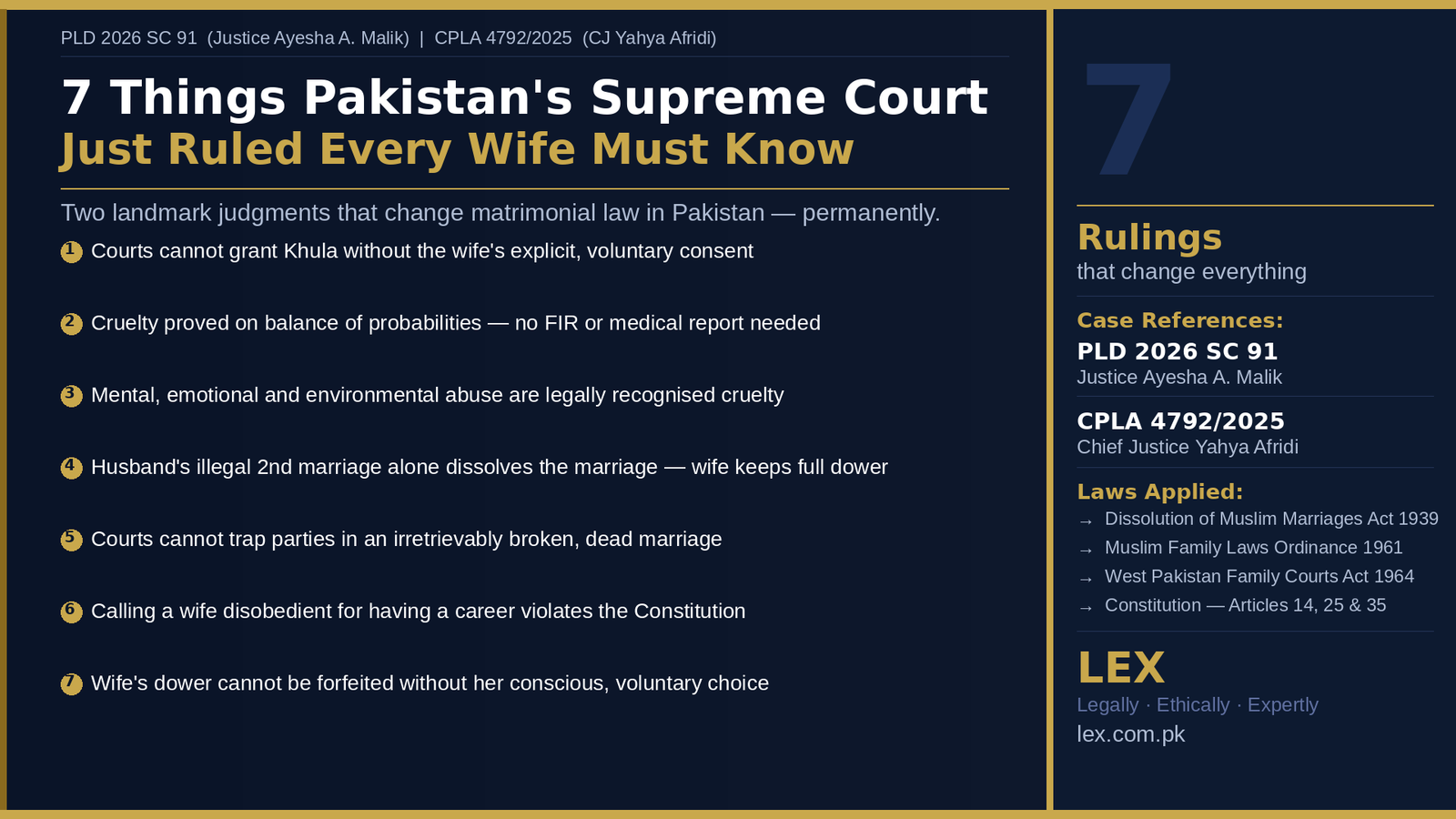
- Courts cannot grant khula without consent when the wife explicitly not asking for it.
- Cruelty does not require to be proved by an FIR or medical report. The standard is now “balance of probabilities” and not strict criminal proof.
- Cruelty now includes mental, emotional and environmental abuse and not just physical violence.
- A husband’s illegal second marriage alone is a complete standalone ground for dissolution and the wife keeps her full dower.
- Where a marriage has irretrievably broken down, courts cannot trap parties in a dead relationship.
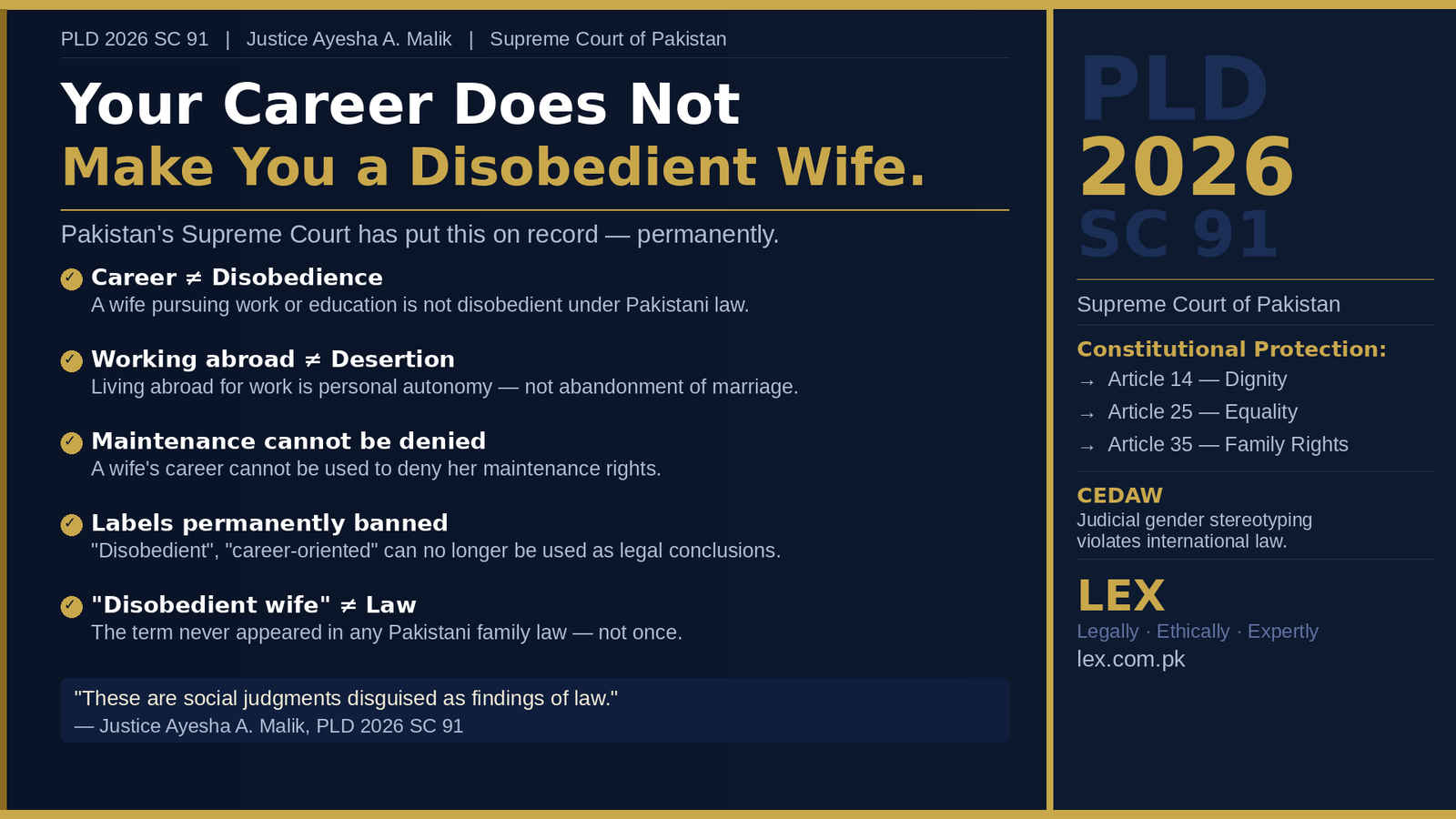
- Calling a wife disobedient for having a career is unconstitutional.
- A wife’s dower cannot be forfeited under khula without consent, conscious, and voluntary choice.
Rulings: PLD 2026 SC 91 (Justice Ayesha A. Malik Judgement) | CPLA 4792/2025 (CJ Yahya Afridi)
Introduction
These two PLD 2026 SC 91 (Justice Ayesha A. Malik Judgement) | CPLA 4792/2025 (CJ Yahya Afridi) judgments have changed the ground rules of matrimonial litigation in Pakistan. Together they settle important points that Pakistani Family Courts have been practicing wrong for years. Courts cannot grant Khula without consent where the wife explicitly is not asking for it. Cruelty does not require an FIR, a medical report, or an eyewitness, the standard is balance of probabilities, not criminal proof. Cruelty is no longer limited to physical violence, it now includes mental, emotional, and environmental abuse. A husband’s illegal second marriage alone is a complete ground for dissolution, and the wife keeps her full dower. Where a marriage has irretrievably broken down, courts cannot trap parties in a dead relationship. Calling a wife disobedient for having a career violates the Constitution. And a wife’s dower cannot be forfeited without her conscious, informed, voluntary choice. If you are a woman who has been through Pakistani Family Courts or is about to go through them these seven rulings are yours to know and use.
Thing 1: Courts Cannot Grant Khula Without Consent of the Wife
No. A court cannot grant Khula without the wife’s explicit, informed consent. This is now settled law at the highest level of legal system’s hierarchy.
For a long period of time, a troubling pattern existed in Pakistani Family Courts. That when a woman filed for dissolution on grounds of cruelty or neglect and the court could not find what it considered sufficient proof, it would itself convert her case into Khula without consent from the wife and without explaining her the consequences, and sometimes without her understanding what had just happened. The reasoning was: she clearly does not want to live with him, so let us call it Khula and move on.
The legal problem with this approach is serious. Khula and dissolution of marriage under the Dissolution of Muslim Marriages Act 1939 (hereinafter will be termed as “DMMA”) are two entirely separate remedies. Although, apparently they look similar as both ends the marital tie between the spouses. But they are entirely different in terms of financial liabilities.
To understand, when a marriage is dissolved on statutory grounds under the DMMA i.e., whether for cruelty, failure to maintain, or the husband’s second marriage without permission, the wife keeps her dower in full. It is because, the marriage ends as the husband’s conduct made the marriage impossible to continue.
On the contrary, Khula is the wife’s voluntary choice. She chooses to end the marriage in exchange for returning part or all of her dower in other words she is essentially paying for her freedom. That choice must come from her free will, with full knowledge of what she is giving up. A court cannot make that choice on her behalf, however convenient it may be.
“Khula is a distinct cause of action grounded in the wife’s consent and autonomy, and it cannot be judicially imposed to replace a failed statutory ground.” PLD 2026 SC 91
The Supreme Court also made clear that filing a suit for dissolution does not itself amount to seeking Khula. Refusing to go back to your husband does not amount to seeking Khula. Expressing that you no longer wish to continue the marriage does not amount to seeking Khula. These are separate things, and courts that treat them as equivalent are committing a legal error with serious financial consequences for the woman.
These principles were reaffirmed in PLD 2024 SC 645 (Ibrahim Khan v. Mst. Saima Khan) and PLD 2025 SC 262 (Dr. Faryal Maqsood v. Khurram Shehzad Durrani), where the Supreme Court had already established that Khula is a distinct remedy founded upon the wife’s clear and voluntary election.
Can you challenge a decree of granted in case of Khula without consent?
If you filed for dissolution on grounds of cruelty, non-payment of maintenance, or your husband’s second marriage or any other ground under DMMA and the court gave you Khula instead, the court may have acted unlawfully. If your dower was taken from you in the process, you may have grounds to challenge that outcome.
Thing 2: You Do Not Need an FIR or Medical Report to Prove Cruelty
Women would come to Family Courts alleging physical abuse, emotional cruelty, sustained humiliation, and mental torture. And the judges would ask: where is your FIR? Your hospital certificate? Your independent witness who saw him hit you? And women would say there is no FIR, no certificate, no witness. Because the abuse happened inside the house in four corners and behind the walls. There were no witnesses. The husband’s family does not testify against him. The wife was afraid, economically dependent, or waiting years before she could finally file and courts would conclude: cruelty has not been proved.
The Supreme Court addressed this directly. The standard of proof for cruelty under the DMMA is the civil standard which is the “balance of probabilities” which mean; is her account more likely to be true than not? That is the only question the court needs to answer.
How to Prove Cruelty in a Case of Dissolution of Marriage?
CJ Yahya Afridi noted that Family Courts routinely demand independent eyewitnesses of domestic abuse, FIRs for confinement, or medical certificates in every case of alleged physical assault and this “overlooks that marriage is essentially a private relationship conducted within the walls of a home.” That insistence on impossible proof defeats the entire purpose of the DMMA.
The correct approach is neither to demand criminal-standard proof nor to mechanically accept every allegation. It is to look at the woman’s testimony in her own words, the surrounding circumstances, the conduct of both parties, the pattern of behavior, and the overall probabilities and then decide whose account is more likely true.
A practical note: If your Family Court dismissed your cruelty claim solely because you lacked an FIR or medical report and without properly considering your testimony and the surrounding circumstances then that may have been a legal error. The law required more from that court, not more from you.
Thing 3: Cruelty in Marriage Now Includes Mental, Emotional and Environmental Abuse And Not Just Physical Violence
The Court also gave the most expansive and clear definition of cruelty seen in Pakistani matrimonial jurisprudence. Now, cruelty is not limited to physical assault. It includes:
- Physical abuse — slaps, beatings, assault
- Mental cruelty — humiliation, verbal abuse, unfounded accusations of unfaithfulness
- Emotional cruelty — studied neglect, indifference, conduct causing deep anguish
- Environmental cruelty — hostile in-laws whose behavior the husband enables or tolerates
- Coercive control — blocking contact, financial deprivation, confinement
- Conduct making the wife feel unsafe or unable to live with dignity in the marriage
“Cruelty may be physical or mental, intentional or unintentional, premeditated or not. The relevant and decisive factor is the impact of the husband’s conduct on the woman — such that she no longer deems it possible to live with him.” PLD 2026 SC 91
This expanded definition was also supported by 2023 SCMR 246 (Mst. Tayyeba Ambareen v. Shafqat Ali Kiyani) and domestic violence enactments, which have progressively widened the scope of what constitutes cruelty in matrimonial proceedings.
Thing 4: A Husband’s Illegal Second Marriage Alone Is Enough to Dissolve the Marriage
Many Pakistani women do not fully appreciate the legal strength of this ground. So let us be direct about it.
Under Section 6 of the Muslim Family Laws Ordinance 1961, a husband who wants to marry again during the subsistence of his existing marriage must first seek his wife’s consent and has to obtain formal permission from the concenred Arbitration Council. The Arbitration Council can only grant that permission if it is satisfied the proposed marriage is “necessary and just.” There is no shortcut. There is no presumption in the husband’s favor.
If he ignores this process and marries anyway, Section 6(5) of the MFLO makes him criminally liable and the consequences may lead to imprisonment, fine, or both. Law also requires husband to immediately pay his existing wife the entire unpaid dower. But there is a further consequence that these rulings make unmistakably clear.
Section 2(ii-a) of the DMMA inserted specifically by the MFLO gives a wife the right to dissolve the marriage if her husband has taken an additional wife in contravention of the MFLO. In Dr. Seema’s case, the husband admitted in his written statement and in oral evidence that he had contracted a second marriage. The Supreme Court stated flatly that this single ground was sufficient for the Family Court to dissolve the marriage. No cruelty proof needed. No maintenance calculation needed. The second marriage done without permission was enough.
“The second marriage was contracted in clear violation of Section 6 of the MFLO, thereby attracting clause (ii-a) of Section 2 of the DMMA, which alone was sufficient for the Family Court to dissolve the marriage. This fact was totally ignored by all three courts.” PLD 2026 SC 91
The financial consequence of this is important. When dissolution is granted on this ground, the wife does not forfeit her Haq Mehr. She keeps everything. The law does not punish a woman for her husband’s unlawful conduct by making her pay to leave.
If you are facing this situation: If your husband has contracted a second marriage without your consent and without Arbitration Council permission, speak to a lawyer without delay. You have a strong, clearly established ground for dissolution and you should not have to give up your dower to exercise it.
Thing 5: If the Marriage Is Dead, the Court Cannot Keep You Trapped In It
The Court also addressed that if the case for dissolution under statutory ground was dismissed, it would leave the parties “legally fastened to a union that survives only in form but has ceased to exist in substance.” That is not justice. Family jurisdiction, the Court said, is not meant “to preserve hollow legal ties after the matrimonial bond has irretrievably broken down, nor to render sterile declarations divorced from practical realities.”
The dead marriage doctrine recognized since Khurshid Bibi v. Muhammad Amin (PLD 1967 SC 97) — means courts cannot compel parties to remain legally bound to a marriage that no longer exists in any real sense. Both dissolution and Khula remain available. The difference is who decides, and on what terms.
There are financial stakes of the choice you make. Elect Khula and you may surrender dower. Pursue the statutory ground and if succeed, you can keep the dower. The court must ensure you understand that before it proceeds.
Thing 6: Calling a Wife Disobedient for Having a Career Violates the Constitution
If a woman pursues her career and gives value to her professional life, it does not make her a disobedient wife. This is one of the most important observations in the judgment. The Supreme Court held that a wife’s desire to pursue her career or education abroad is not disobedience. It is the exercise of personal autonomy protected under Articles 14, 25, and 35 of the Constitution of Pakistan.
The Supreme Court directed Family Courts to move away from words like “disobedient,” “self-deserting,” “mummed,” and “compelled the husband to contract a second marriage.” These reinforce a moral hierarchy that measures women by servitude and compliance in total disregard of their fundamental rights.
This ruling is covered in full detail including maintenance rights, CEDAW obligations, gender-sensitive adjudication, and what courts can no longer say, in our dedicated blog: Your Career Does Not Make You a Disobedient Wife | Pakistan’s Supreme Court Just Put That on Record | LEX
Thing 7: Your Dower Cannot Be Taken Without Your Conscious, Voluntary Choice
The financial consequences of these rulings deserve their own clear explanation because this is where most women feel the impact most directly.
When a marriage is dissolved by way of Khula, it is clearly the woman’s choice and she has to return or waive some part of her dower as per law. But in cases of dissolution where cruelty, non-maintenance, or the second marriage ground has been taken, the woman does not have to return anything. On the contrary, she is rightfully entitled to her full dower. The court cannot switch the wife’s rights and relinquish her right of dower on its own. Her conscious consent is required.
The position, as now clearly stated, is this:
- Where dissolution is granted on statutory grounds under the DMMA such as cruelty, failure to maintain, illegal second marriage, and others, the wife retains her full dower. No return, no forfeiture.
- Where the wife voluntarily elects Khula with full understanding of the consequences, she may be required to return some consideration or waive unpaid dower. This is her choice to make.
- A court cannot impose the Khula without consent and needs wife’s conscious, on-the-record, fully informed consent.
- Maintenance is owed for the period during which the marriage subsisted. Alleged disobedience is not a legal defense to a maintenance claim. Courts must assess whether maintenance was actually paid, not dismiss the claim with a label.
What happens to your dower if the court gives you Khula without consent?
You may have lost dower you were not legally required to forfeit. Whether you can challenge what happened depends on where the case stands procedurally, but the legal ground is now clearly in your favor. LEX regularly handles cases where women’s financial rights were wrongly stripped through improper Khula decrees. A consultation is the right first step.
What This Means for Overseas Pakistani Women?
If you are reading this from the UK, the USA, Canada, the UAE, or anywhere outside Pakistan these rulings are directly relevant to you.
Overseas Pakistani or foreign national women who seek dissolution of marriage in Pakistan face a particular version of every problem described in this article. The fact that you live abroad, work, have your own finances, and do not reside permanently in the matrimonial home is regularly used against you in Family Courts in Pakistan. Your independence is called disobedience. Your absence is called desertion. Your dissolution suit is converted into Khula without consent your understanding and your dower disappears.
These rulings close that argument. Pursuing a career is not disobedience. Living abroad with your husband’s knowledge is not desertion. And a court that converts your dissolution suit into khula without consent is acting contrary to the highest judicial authority in Pakistan. The process of pursuing dissolution from abroad is also manageable. You do not need to come to Pakistan for court hearings. A Special Power of Attorney, properly attested at the Pakistani Embassy in your country, allows a representative in Pakistan to handle the case. The E-Court system allows your testimony to be recorded via video call. LEX handles these cases for women in the UK, USA, Canada, the UAE, Spain, and elsewhere.
How LEX Can Help?
These rulings matters but understanding how they apply to your specific situation requires someone who actually knows the law and the courts. The difference between a dissolution decree and a Khula decree can mean the difference between keeping your dower and losing it entirely. The difference between the right standard of proof and the wrong one can mean the difference between your cruelty claim succeeding or failing. LEX handles dissolution of marriage, Khula, dower recovery, maintenance, and second marriage cases including for overseas Pakistanis who need to manage proceedings remotely. If your case involves any of the issues discussed in this article, reach out. The first conversation costs nothing. The clarity it gives you is worth a great deal.
Final Words
The two rulings covered in this article say something that has needed to be said at the highest level for a very long time. Courts cannot take your Khula without asking you. Cruelty is not invisible because you have no FIR. Your husband’s illegal second marriage is a complete ground for dissolution and you keep your dower. And the law does not exist to maintain marriages that have already ended in everything but paper.
These are not new rights. They were always in the DMMA, in the MFLO, in the Constitution. What is new is a Supreme Court that said them plainly, directly, and on the record.
If you are sitting with a family matter that touches any of these issues whether you are in Pakistan or abroad, whether your case is pending or already decided you deserve to know where you stand. The law is clearer now than it was before. Use it.
Disclaimer
The information provided in this blog is for general awareness and educational purposes only. It does not constitute legal advice and should not be treated as such. Every case and situation is different, and the law can be interpreted differently depending on the circumstances. If you need legal advice specific to your situation, please consult a qualified lawyer before making any decisions. LEX does not assume any liability for actions taken based on the information published in this blog.
Frequently Asked Questions (FAQs)
Can a Pakistani Family Court grant Khula without the wife asking for it?
No. The Supreme Court in PLD 2026 SC 91 held that Khula cannot be imposed by a court without the wife’s explicit, informed, on-the-record consent. Filing a dissolution suit does not amount to asking for Khula. Refusing to live with the husband does not amount to asking for Khula.
What is the difference between Khula and dissolution under the DMMA?
Dissolution under the DMMA is to file plaint to end marriage on grounds of cruelty, failure to maintain, illegal second marriage or other statutory grounds and the wife keeps her full dower.
Whereas, Khula is the wife’s voluntary choice to end the marriage by returning some dower in exchange for release.
Do I need an FIR or medical report to prove cruelty in a Pakistani Family Court?
No. The standard of proof for cruelty under the DMMA is the balance of probabilities You are no longer required to produce an FIR, a hospital certificate, or an independent eye witnesses. Your testimony, the surrounding circumstances, and the overall pattern of conduct are all valid evidence.
If my husband married a second wife without permission, can I dissolve the marriage?
Yes, this ground alone is enough. Under Section 2(ii-a) of the DMMA, a husband contracting an additional marriage in contravention of Section 6 of the MFLO 1961 gives the wife the right to seek dissolution and you keep your full dower.
If the court dissolves my marriage on statutory grounds, do I have to return my dower?
No. When dissolution is granted on grounds under the DMMA for example cruelty, failure to maintain, illegal second marriage or orhters the wife retains her full Haq Mehr. There is no return obligation. Dower return is associated only with Khula, and only when the wife has voluntarily elected it.
What happens if my cruelty claim is not proved but my marriage has completely broken down?
Under CPLA 4792/2025, the court cannot dismiss the case and leave you trapped in a dead marriage but it also cannot impose Khula on you without consent. The correct course is for the court to explain your options: pursue the cruelty claim knowing the evidentiary risk, or elect Khula with its financial consequences. The choice must be yours, consciously made, with full information.
What is the dead marriage doctrine in Pakistani law?
The dead marriage doctrine, recognized since Khurshid Bibi v. Muhammad Amin (PLD 1967 SC 97) and reaffirmed in CPLA 4792/2025, holds that courts cannot compel parties to remain legally bound to a marriage that has ceased to exist in substance. Where cohabitation has ended, reconciliation is impossible, and the marriage exists only on paper, the court has the power and the responsibility to dissolve it in a just and realistic manner.
Can I challenge a Khula decree that was granted without my consent?
If a court granted Khula against you without asking for your consent, without recording your choice on the record, and without ensuring you understood the financial consequences, that may constitute a legal error. Whether it can be challenged depends on the stage of proceedings and whether appeals or constitutional petitions are still available. If this happened to you, consult a lawyer to assess your specific position.
Can my husband be convicted for contracting a second marriage without permission?
Yes. Under Section 6(5) of the Muslim Family Laws Ordinance 1961, a husband who contracts a second marriage without his existing wife’s consent and without Arbitration Council permission is criminally liable and punishable with imprisonment, fine, or both. He is also required to immediately pay his existing wife the entire outstanding dower.
For questions about the ‘disobedient wife’ ruling and maintenance rights
Read our dedicated blog: “She Wanted a Career. The Judge Called Her Disobedient. The Supreme Court Called It Unconstitutional.” It covers the complete ruling on patriarchal court language, CEDAW obligations, gender-sensitive adjudication, maintenance rights of working wives, and Articles 14, 25 and 35 of the Constitution. → https://lex.com.pk/blogs/disobedient-wife-pakistan-career-overseas-supreme-court/